The Pollica project room
The question a client conversation actually turns on is not whether something is built, but whether it survives being opened without you in the room. Three answers, and only the first is a link you can send and walk away from.
Send it
A link in an email. No preamble, no call, nothing to explain first.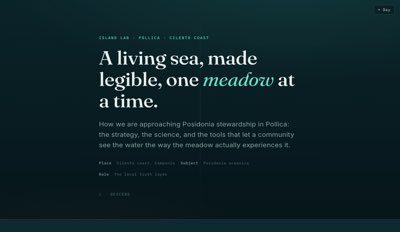
The approach
sendThe strategy, the science and the tools, written to be read start to finish by someone who has never heard of us.
/pollica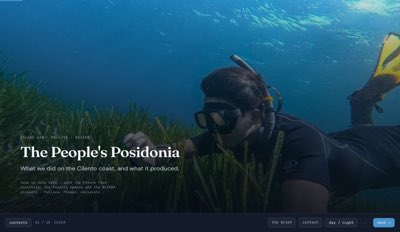
What we did on the water
sendThe week itself: photographs from the boat and the classroom, each tied to the tool it produced.
/pollica/story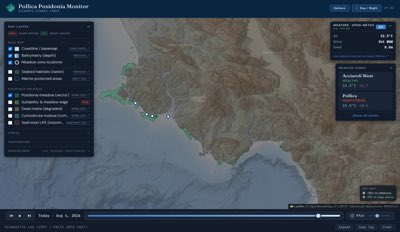
The meadow map
sendThe coast as a grid of meadow density and per-zone stress. Opens with the coast already loaded.
/pollica/demo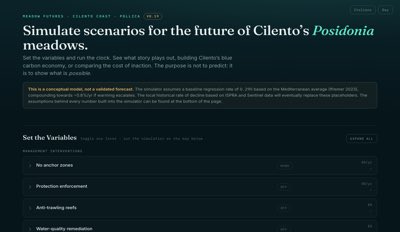
Meadow Futures
sendPull the levers a town actually holds and watch the meadow to 2100. Says on its face that it is a model, not a forecast.
/pollica/futures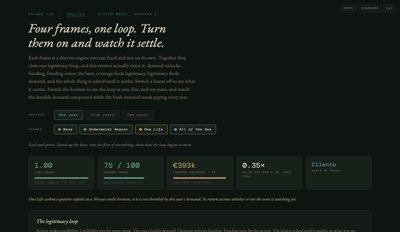
How it pays for itself
sendFour frames turning one loop, settling at one, five and ten years. The economics without a spreadsheet.
/pollica/model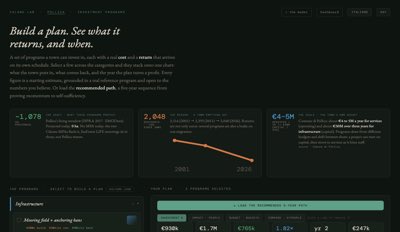
The plays, costed
sendEvery candidate program priced and sequenced under a budget cap, so a funding conversation starts from numbers.
/pollica/invest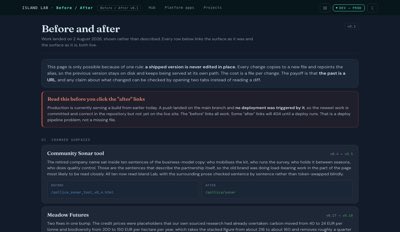
Before and after
sendOne defect, shown honestly: the old rule deleted disagreement with the 2017 map, the new one draws it.
/before-after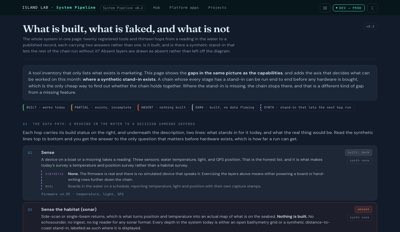
What is built, faked, absent
sendThe whole system with its gaps drawn in. For a technical reader this is the most credible page we have.
/pipelineWalk it
Real and worth showing, and it lands only with someone narrating. Sent cold, each of these invites the wrong question.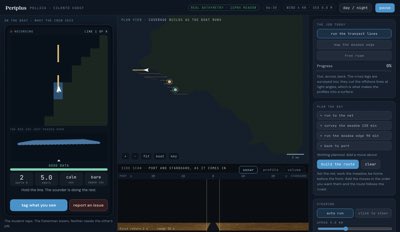
A survey day, simulated
walkThe best stand-in we have: speed, sea state, coverage, fuel and hours draining across a working day. It needs the framing that the day is simulated and the depth is not.
/periplus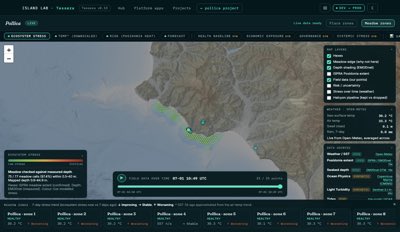
The comparison
walkCovered, known, and the difference. Three panels, and they need a survey session pasted in before there is anything to see.
/tessera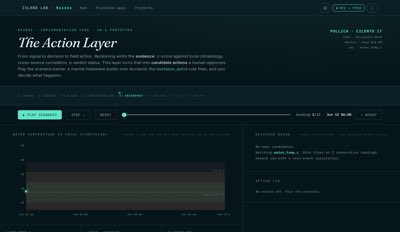
A signal becoming a decision
walkA heatwave builds, actions appear by tier, a human accepts or dismisses each one. A strong five minutes, told; a puzzle, opened cold.
/kairos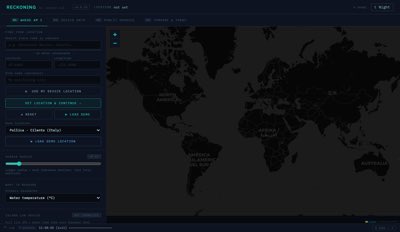
Sources against the model
walkEvery public source for a place, set against the global model: correlation, drift, anomaly. Dense on purpose, and it rewards being read to.
/reckoning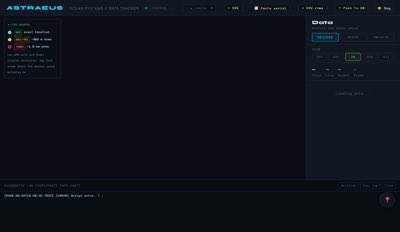
The fleet
walkThe live heartbeat of every device. It has to be walked, because nothing has reported since 8 July and the page cannot say why on its own.
/triton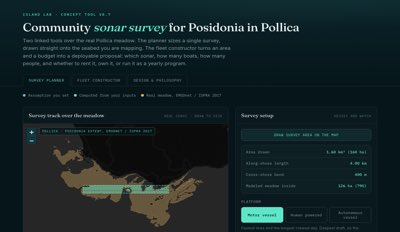
The sonar planner
walkPlans a community survey over the real meadow. In no registry, and it overlaps two other planners, so it is shown as a sketch rather than a product.
/pollica/sonarHold
Ours. Useful in the room with us, wrong to hand over.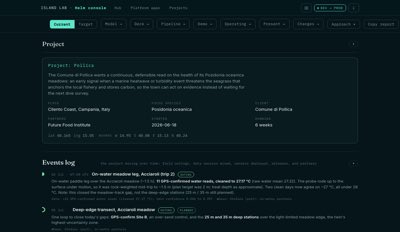
Helm, the console
holdEvery dataset and its provenance, the events log, the project path. Reads as a to-do list to anyone outside the build.
/helm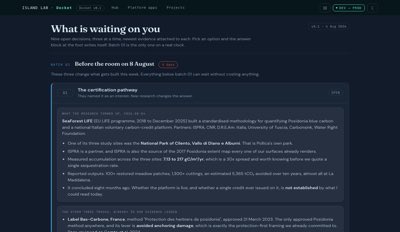
The docket
holdThe open decisions, three at a time, each with its evidence and a recommendation. Internal by construction.
/decisions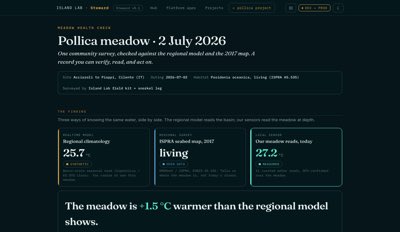
Steward
holdDeclared a field-ready health check and currently a print brief with fixed numbers. Held until it reads a real input.
/steward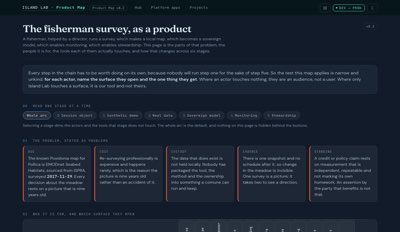
The product map
holdSeven actors, the tools each touches, and which light up at each stage. A working reference, not a pitch.
/product-mapWhat has been written down, who each piece is for, and what state it is in. A document with no audience named is a draft, whatever its version number says.
The brief
v0.2The People's Posidonia: the full statement of the project, with the figures and the citations behind them.
/pollica/brief nextA second document of the same name and version sits at /pollica/people. Settle which is canonical.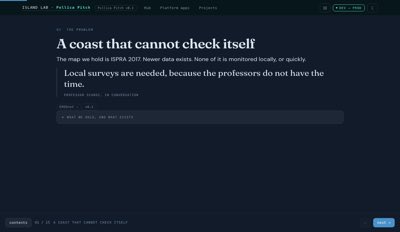
The pitch
v0.1Bottom-up monitoring, argued short. The compressed case, for a reader who will not open eight tabs.
/pollica/pitch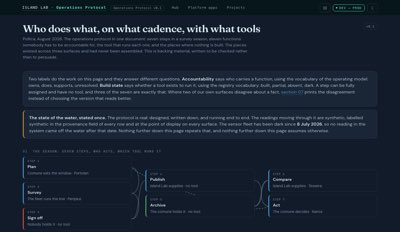
The operations protocol
v0.1Who does what, on what cadence, with what tools. The answer to the first question a large organisation asks.
/pollica/operations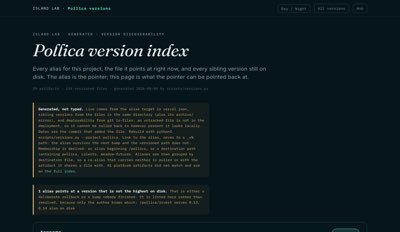
The version index
liveEvery Pollica artifact and every version of it, with the previous states still reachable. The receipt for the versioning rule.
/pollica/versions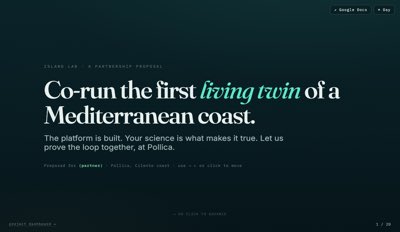
The deck
v0.4The click-through argument: the problem, the method, the coast, the ask. The front of which this page is the back.
/pollica/partner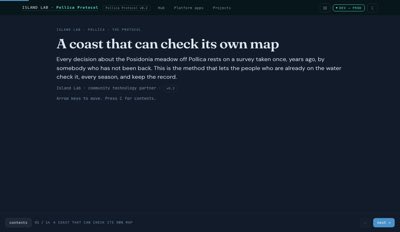
The protocol, run of show
v0.2A coast that can check its own map, told in the order it is presented. The narrative spine for a live session.
/pollica/run-of-show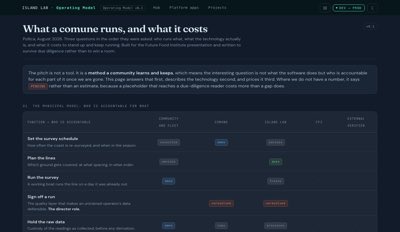
The operating model
v0.1Who is accountable for what, once the instruments are in the water and we are not standing next to them.
/pollica/operating-model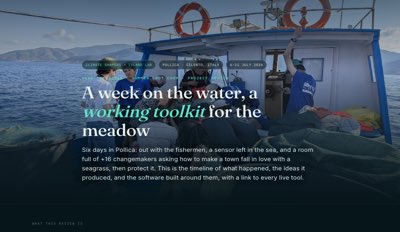
The week, reviewed
v0.2The timeline of the teaching week and what each day produced. Note that this and the story page are two separate artifacts.
/pollica/review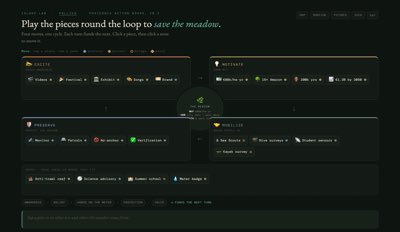
The community toolkit
v0.2The pride and action pieces that a town plays round the loop. Community-facing, not technical.
/pollica/toolkit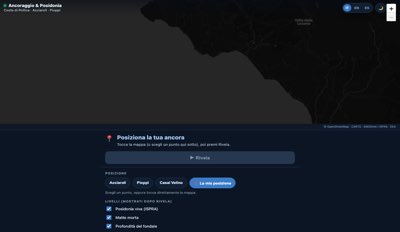
Anchoring, for boats
v0.2The one-screen ask aimed at whoever is about to drop an anchor on a meadow. The most public thing we have.
/pollica/anchor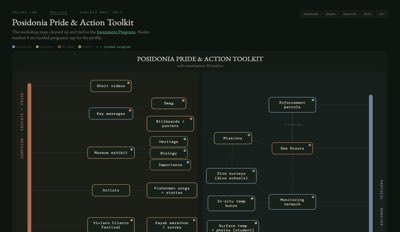
The toolkit map
v0.3The same toolkit as a map of pieces and how they connect, for planning rather than for reading.
/pollica/mindmapCheck which file an alias serves before you send it
Two documents currently carry the name pollica-brief-v0_2: one at /pollica/brief and a different one, same title and same version number, at /pollica/people. They differ by about a quarter of their content. Separately, /pollica/review and /pollica/story are two genuinely different documents whose filenames are mirror images of each other, bootcamp-review against review-bootcamp.
Nothing here is broken, and both hazards have the same shape: the filename does not say which document it is. The naming scheme that fixes it, kind plus audience plus version, is drafted and not yet ratified. Until it is, open the link before sending it.
Grouped by where they sit in the data path. The build status is what the code supports, and the next line is the one thing that would move it, not a wish list. The hop-by-hop argument, including what has a synthetic stand-in and what does not, is on the system pipeline.
Sense and carry
The water into the system.
Triton
darkThe sensor fleet view. It works; nothing is reporting into it, and none has since 8 July.
/triton nextA device in the water, then one smoke row against the v1.0.4 contract before the version is promoted.
Reckoning
builtIngest and fusion, running. Everything it has fused so far was invented upstream.
/reckoning nextNothing, until there is a real row to fuse.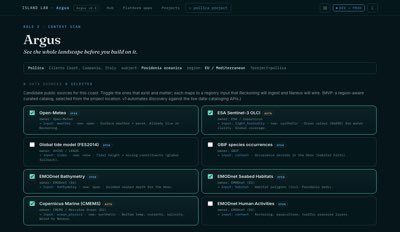
Argus
builtSite context intake, reading real sources, feeding the project manifest.
/argus nextPoint it at the next coast, which is the test of whether the intake is portable.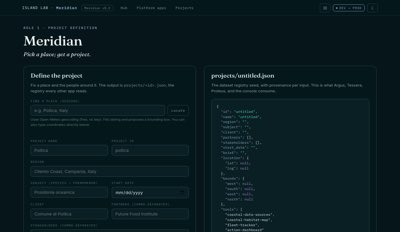
Meridian
builtWrites the project config every other app reads, and is where the word synthetic enters the system.
/meridian nextNothing pending. It does its job.Survey
Four surfaces claim this territory, which is one of the open decisions.
Periplus
partialRuns a survey day and, since v0.8, emits a session file the rest of the chain can read.
/periplus nextImport a plan, so a route drawn in Portolan actually drives the day.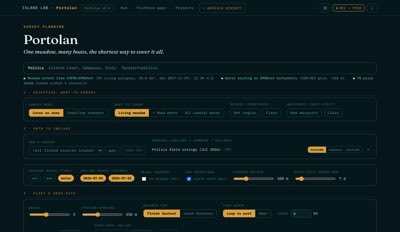
Portolan
partialPlans a survey and exports a route that nothing currently reads back in.
/portolan nextThe consolidation decision. Until then it plans into a void.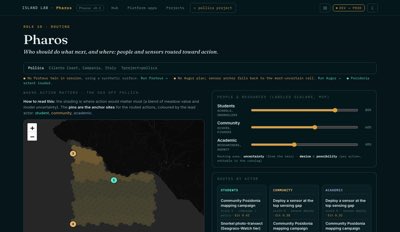
Pharos
partialRouting. Overlaps Portolan, and both plan over a synthetic distance-to-coast depth.
/pharos nextFold into whichever surface wins, or state why it stays separate.
Community sonar
partialA fourth planner, in no registry, built for a community crew rather than a survey vessel.
/pollica/sonar nextRegister it or retire it. A tool nobody can be told to use is not a tool.Map and compare
Where a survey turns into a claim about the meadow.
Tessera
builtThe comparison surface. Covered, known and the difference, on one grid, with disagreement drawn rather than deleted.
/tessera nextReal cells. The rule is right; the numbers in it are still invented.
The hex map
builtThe client-facing coast: meadow density, per-zone stress, current conditions, advisories.
/pollica/demo nextConverge its visuals into Tessera rather than maintaining two maps.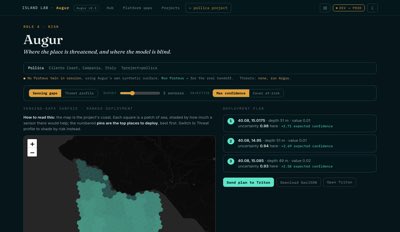
Augur
partialRisk over inputs that are themselves invented, which makes the number a demonstration of the arithmetic.
/augur nextA no-mask banner, so a surface that cannot see land says so.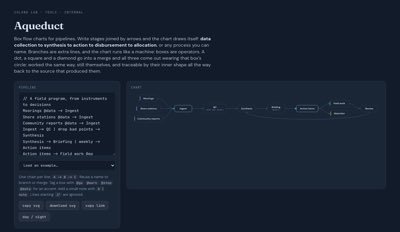
Aqueduct
partialExplains how a value moves and is scored, with worked examples. Off the delivery path, so being synthetic costs it nothing.
/aqueduct nextNothing. It is doing what it is for.Model, act and govern
What the meadow does next, and who does something about it.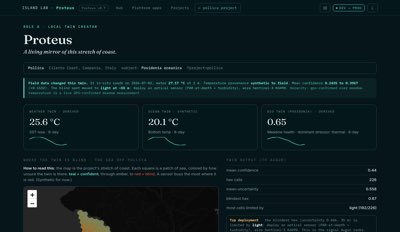
Proteus
partialThe local twin. A single-box model, not a per-cell simulation, running on synthetic forcing.
/proteus nextTake survey quality as an input, so a better survey visibly narrows the result.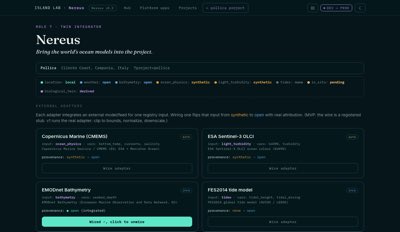
Nereus
partialIntegrates twins that are themselves partial, so it has no fixture of its own to fail against.
/nereus nextWaits on Proteus.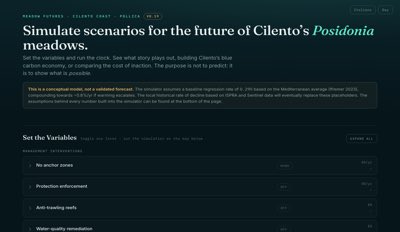
Meadow Futures
partialScenarios to 2100 with the economics attached. Prices are sourced; the ecology is the invented half.
/pollica/futures nextFeed it a measured baseline instead of a synthetic one.
Kairos
partialA finding becomes an action. The object exists; the routing to an owner is thin.
/kairos nextA named owner who can accept, decline or let an action lapse, with the response recorded.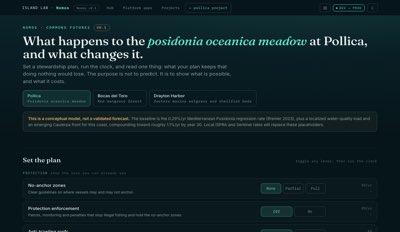
Nomos
partialCommons and governance scenarios. Nothing here was ever going to be measured; the test is whether the rules are plausible.
/nomos nextTie a scenario to a real decision, which needs a decision object to exist.
Docket
newThe open decisions with evidence and a recommendation attached. Choices live in the browser, and the page says so rather than claiming to write a file.
/decisions nextAnswer the three on the shortest clock.The three stages nothing is built for
Past the act layer the chain stops, and it stops in the places that decide whether any of this was worth doing.
- Publish and hold. No frozen season, no custody handover. The migration is written and has never been applied, which is why nothing downstream has an input.
- Decide. No decision object, and no record of what evidence a rule rested on. A worked example needs no hardware and no partner, only the decision to build it.
- Record. One snapshot, not a series, and no format for the method to travel alongside the numbers.
Sprint 010, the survey system: build the picture, then the demo, then the tools underneath it, in that order, so that at close a person who was not in the room can be shown the whole system in one view, watch a simulated survey produce a real artifact, and see that artifact disagree with the 2017 map where it actually disagrees.
The product map exists
The problem set, seven actors, the tools each touches, and which light up per stage. Live at /product-map.
Stop deleting the disagreement
A cell outside the 2017 extent renders as disagreement instead of being discarded. Found en route: the committed landmask was the legacy build and re-deleted the same nearshore cells as land, so it was rebuilt at 60 m.
The survey session object
A session round-trips to disk and back with its provenance intact, and a rebuild is byte-identical.
Periplus emits a session
A simulated day now survives itself: the track, every sounding at the quality it was taken at, the coverage and what the day cost.
The comparison panel
What I covered, what was known, and the difference, with an unsurveyed cell visibly distinct from an agreeing one. This is the demo screen the story rests on.
One grid
Two grid systems were shipping on one map, hidden only because a layer was off by default. Now one.
Close the plan-to-boat loop
A route planned in Portolan drives a Periplus run, and the session points back at the plan it came from. Gated by the consolidation question below.
Run the loop once, properly
Brief, demo, review, in three different rooms. First room is the director and a fisherman, because if the run does not look like a real working day the rest is theatre. The objections get written down unedited and become the next brief.
Blocked, not dropped
None of this is sprint work. Each needs a device, a console, or a decision, and each stays visible until it moves.needs a deviceUntil one real reading lands against the current contract, the top of the chain stays untested and two risks have no evidence behind them.
needs a consoleWritten, never applied. It is what would turn a season into a held record, so three later stages wait on it.
needs a decisionFour surfaces plan or run a survey. Which one is the planner gates the plan-to-boat loop.
needs a decisionThe role carries sign-off in the session schema and does not exist in the data model. A name and a permission, or the field is decoration.
The same discipline produced every surface on this page, and it is most of what makes the work checkable by someone who was not there.
A tool gets its slug, role and status in the registry before it gets a file. The unregistered sonar planner above is the exception that proves why: nobody can be told to use it.
Nothing shipped is edited in place. A change copies to the next version and repoints a stable alias, so the previous state stays reachable and any claim about what changed can be checked by opening two tabs.
Local, open, derived, calibrated, synthetic, pending, none. Synthetic is a legal value on purpose, which is what lets a stand-in run in front of a client without pretending.
Verified, partly true, incorrect, or unverifiable, recorded against the source. A claim with no verdict is a draft, not a fact.
A route check confirms every alias resolves to a file that will deploy, and a manifest that proposes a tool for every question fails on purpose, because a system that always has an answer is not answering.
Every figure on every map is synthetic and says so where it is displayed. The protocol is real; the measurement is the next stage, not a claim we are making today.