Cooperation and collective brains
Four dot models from Joseph Henrich's account of cultural evolution. Each one turns a single idea into something you can run: who meets whom, what people copy, and how groups, towns and connections shape cooperation and invention.
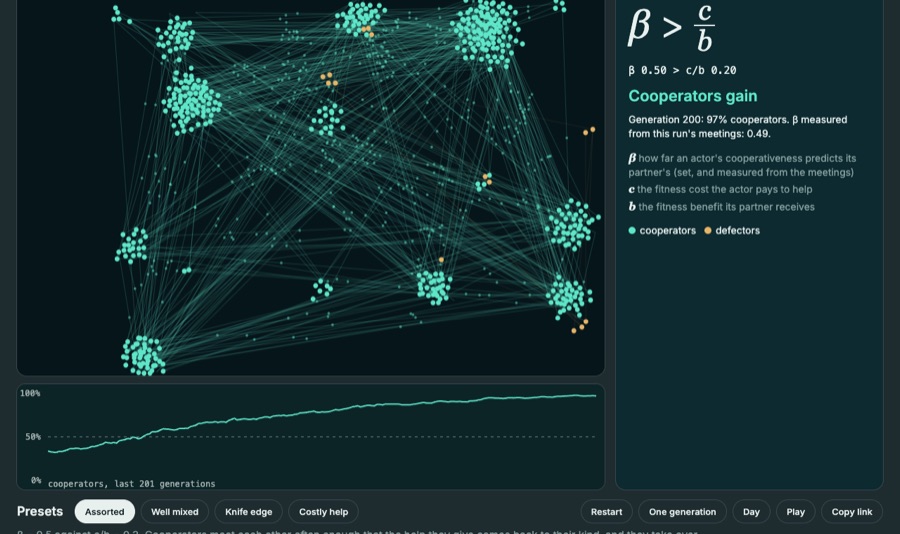
Cooperation evolves when phenotypes assort
Pairs meet, cooperators pay c to give b, and cooperation spreads exactly when β clears c/b.
/assortment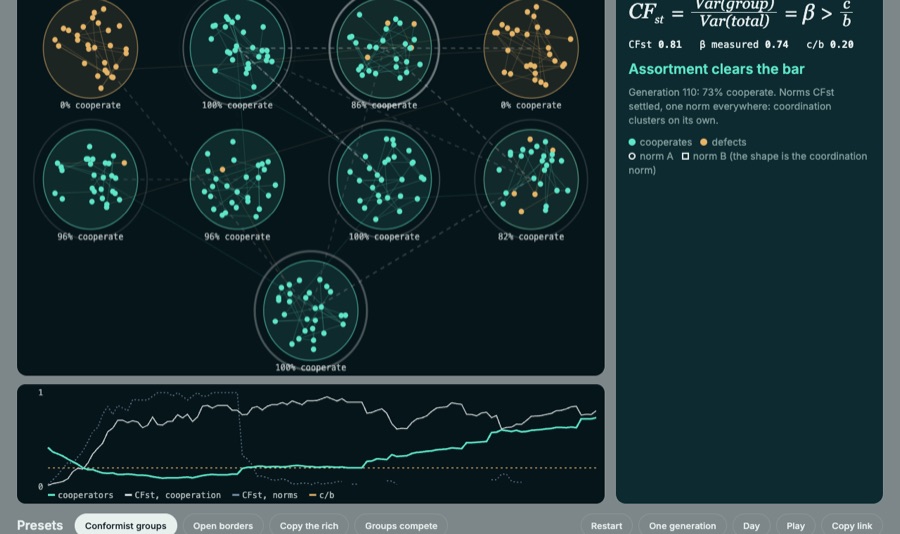
Groups make the assortment cooperation needs
Conformity, copying and group competition build cultural CFst, the β that lets cooperation hold.
/assortment/groups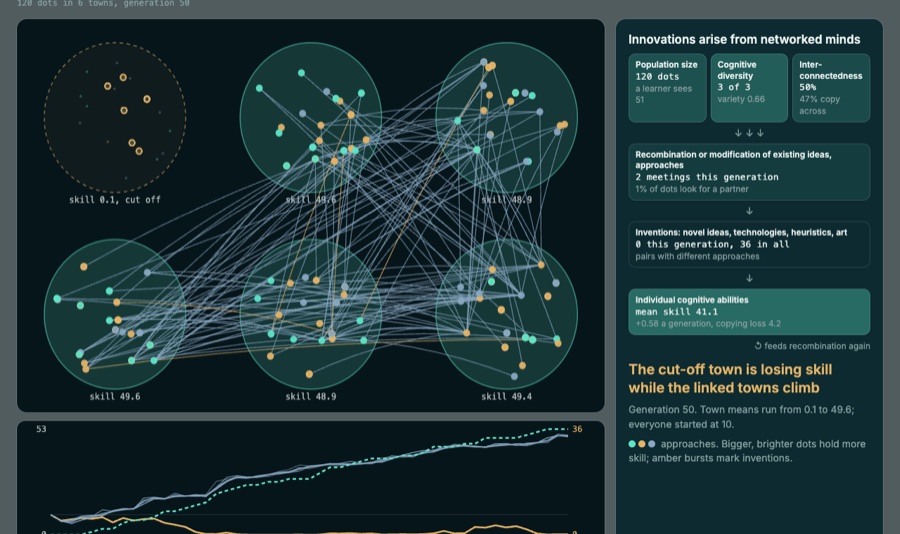
Big, linked, diverse groups ratchet their skills up
The collective brain: copying, recombining and inventing, with the Tasmania effect when a town is cut off.
/collective-brain
Whatcom's towns as cultural groups
The groups model on 19 real towns, with LODES commuting along the roads and four levers to place.
/bellingham/assortment, behind the Bellingham passphraseSources: Henrich (2004, American Antiquity) and Muthukrishna and Henrich (2016, Phil Trans R Soc B) for the collective brain; Fletcher and Doebeli (2009) for the assortment rule; Bell, Richerson and McElreath (2009, PNAS) for cultural Fst; Handley and Mathew (2020, Nature Communications) and Muthukrishna et al. (2020, Psychological Science) for measured values, about 0.01 between US regions.